Large-Scale Structure in COSMOS-Web
Tracing Galaxy Evolution in the Cosmic Web up to z~7 with the Largest JWST Survey
Authors: H. Hatamnia, B. Mobasher, S. Taamoli, J. Kartaltepe, C. Casey, H. Akins, et al.
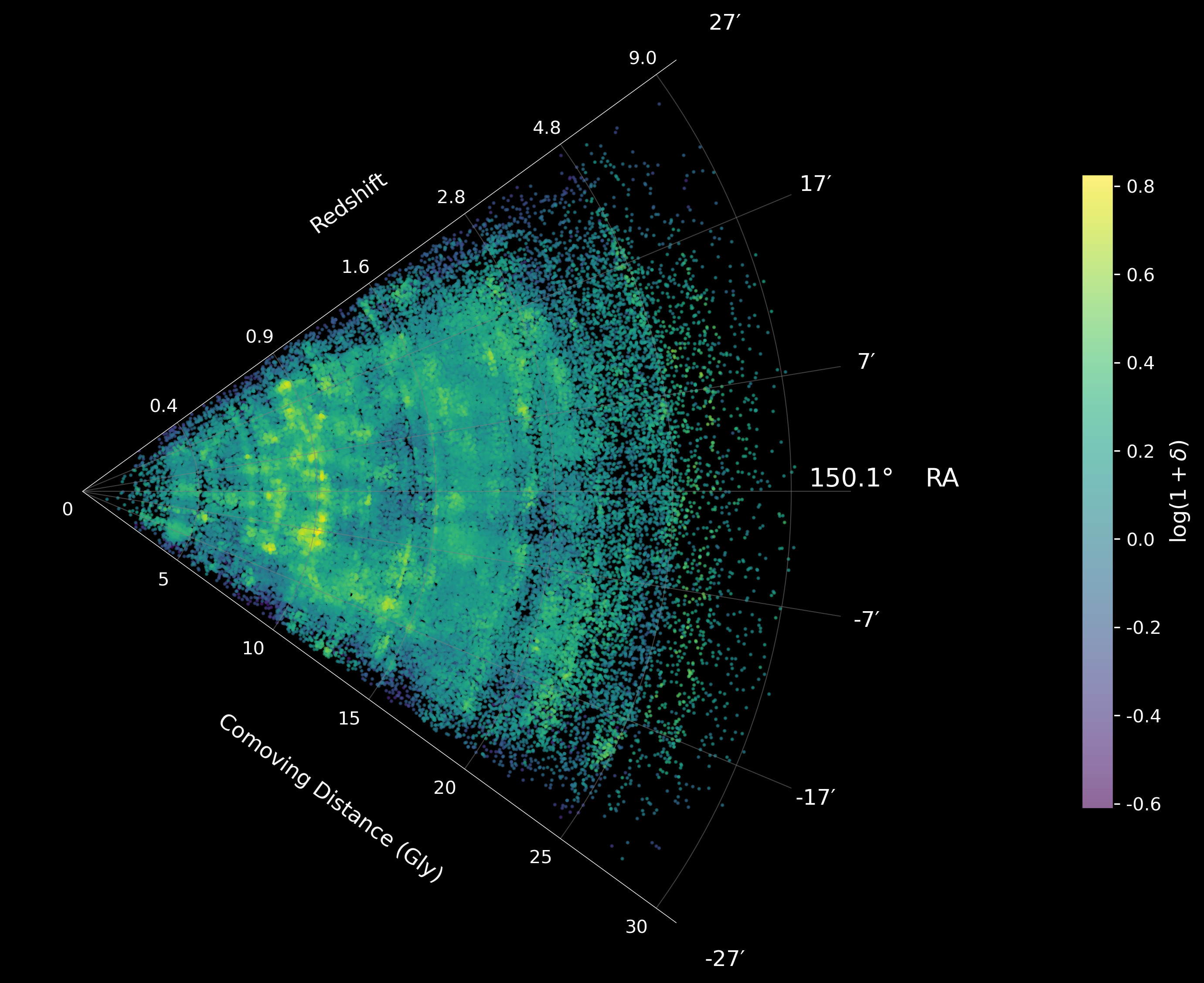
This page presents the large scale structure density maps derived from weighted kernel density estimation to the COSMOS-Web photometric catalog. If you make use of these products, please cite the associated paper:
H. Hatamnia, B. Mobasher, S. Taamoli et al. (2025) "Large-Scale Structure in COSMOS-Web: Tracing Galaxy Evolution in the Cosmic Web up to z~7 with the Largest JWST Survey" arXiv, 2511.10727 [arXiv]
Abstract
We present a reconstruction of the large-scale structure using the James Webb Space Telescope's (JWST) COSMOS-Web program to trace environmentally driven galaxy evolution up to z~7. We applied a weighted kernel density estimation method to 160,000 galaxies with robust photometric redshifts. We find that stellar mass has a positive correlation with density at all redshifts, stronger for quiescent galaxies (QGs) at z ≤ 2.5, while at higher redshifts (2.5 ≤ z ≤ 5.5) this trend is confined to extreme overdense environments, consistent with early mass assembly in proto-clusters. The star-formation rate (SFR) shows a negative trend with density for QGs at z ≤ 1.2, reversing at z ≥ 1.8, while star-forming galaxies (SFGs) show a mild positive correlation up to z~5.5. The specific SFR remains nearly flat for SFGs and declines with density for QGs at z ≤ 1.2. Moreover, mass and environmental quenching efficiencies show that mass-driven processes dominate at z ≥ 2.5, the two processes act with comparable strength between 0.8 ≤ z ≤ 2.5, and environmental quenching becomes stronger for low-mass galaxies \(M_* \leq 10^{10} M_\odot\) at z ≤ 0.8. These findings reveal that large-scale structure drives galaxy evolution by enhancing early mass assembly in dense regions and increasingly suppressing star formation in low-mass systems at later times, establishing the environmental role of the cosmic web across cosmic history. COSMOS-Web, the largest JWST survey, provides accurate and deep photometric redshifts, reaching 80% mass completeness at \(\mathrm{log}(M_*/M_\odot) \approx 8.7\) at z~7, enabling the first view of how environments shaped galaxy evolution from the epoch of reionization to the present day.
Code Availability
The pipeline used to construct the LSS density maps is available on GitHub: https://github.com/hhatam/CosmicWeb. There we also provide an augmented reality animation of the COSMOS-Web field.
Downloads
Coming soon!